
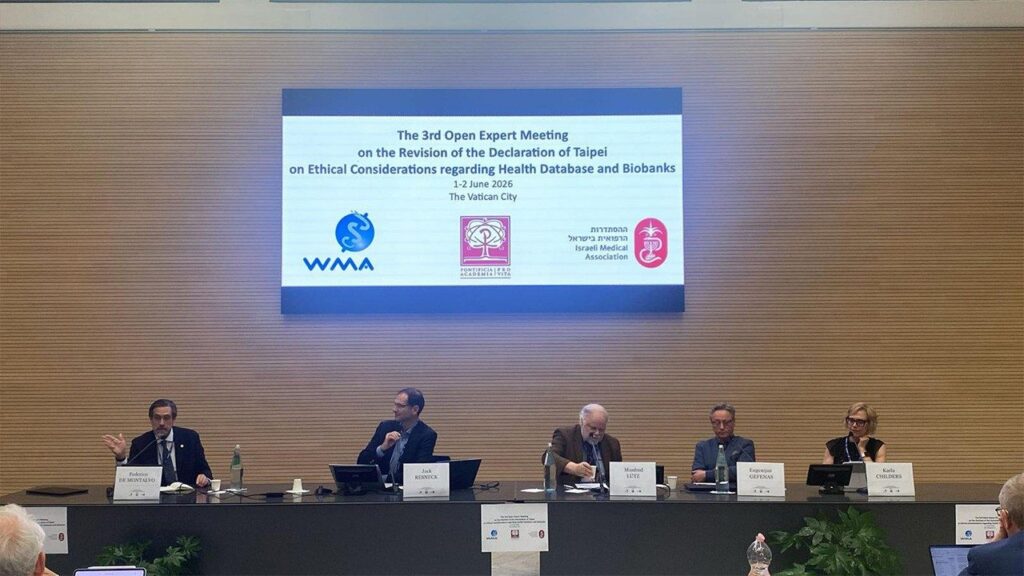
Pope Leo XIV warned against reducing individuals to exploitable data and called for policies that promote both privacy and the common good.
In a message dated 1 June, the Pope called for stronger safeguards to protect human dignity in the collection and use of health data, warning against the growing risk of reducing individuals to exploitable sources of information in the digital age.
The message, dated 1 June, was sent to participants in the Third Open Expert Meeting on the revision of the World Medical Association’s Declaration of Taipei. In it, the Pope noted the urgent ethical challenges posed by rapid technological development.
The message was addressed to Archbishop Renzo Pegoraro, President of the Pontifical Academy for Life, and was signed on the Pope’s behalf by Cardinal Pietro Parolin, Secretary of State.
The Declaration of Taipei
The Declaration of Taipei provides ethical guidance on health databases, biobanks, and related medical research.
As experts work to update the document in light of emerging technologies and new forms of data collection, Pope Leo underscored the importance of ensuring that advances in science and medicine remain firmly grounded in respect for the human person.
New form of colonialism
Referring to his recent encyclical Magnifica humanitas, the Pope noted that contemporary society faces what he described as “a new form of colonialism” that seeks to transform personal lives into exploitable data.
He warned that the continuous evolution of technology has made the revision and strengthening of privacy and security protections an increasingly urgent task.
Inherent dignity of every person
Pope Leo emphasised that every person possesses inherent dignity that cannot be reduced to mere information or commercial value.
Created in the image and likeness of God, each individual is “an irreducible and unique individual of inestimable value,” he said in the message. For this reason, he continued, society must guard against forms of exploitation and commercialisation that treat persons merely as collections of data.
Encouraging the participants in their deliberations, Pope Leo expressed the hope that the revised Declaration of Taipei will continue to uphold human dignity while promoting the responsible sharing of knowledge for the common good. He said that respect for the person and the advancement of shared knowledge should remain the foundation of ethical medical research and healthcare policy.